
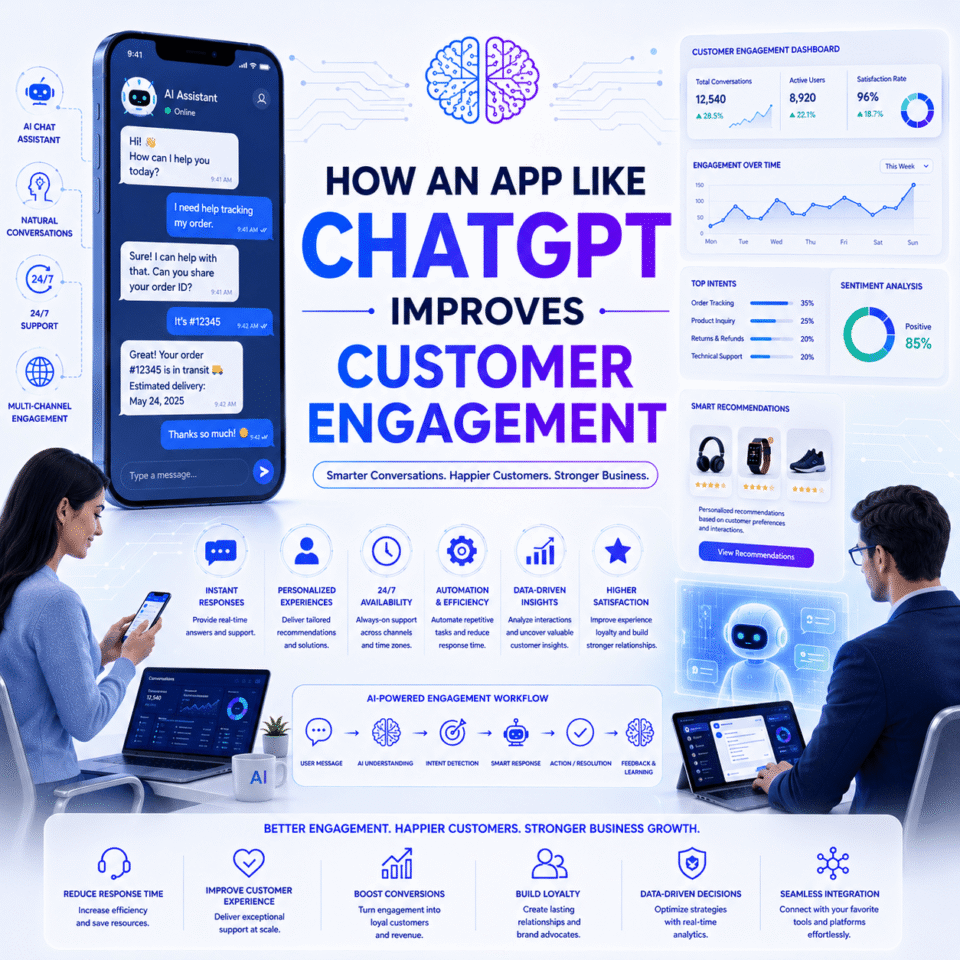
Today’s fast-moving online environment pushes firms to explore new methods of reaching users while offering tailored service. An App Like ChatGPT helps businesses communicate with customers more efficiently by delivering faster responses, smarter recommendations, and automated interactions. Because artificial intelligence tools such as ChatGPT exist, conversations with clients happen faster, include smarter suggestions, and run without constant human help. Driven by results seen elsewhere, organizations in many fields adopt sophisticated bots – not simply to respond quickly but also to build trust over time through consistent interaction. Efficiency gains follow when routine tasks shift away from people toward responsive systems that learn patterns naturally.
Starting with pattern recognition, tools such as ChatGPT interpret user questions using complex computational models trained on vast language datasets. Because of their ability to mimic conversational flow, companies now deliver round-the-clock assistance without delays typically tied to human availability. Instead of waiting hours, customers receive replies within seconds – often shaped by prior interactions. Personalized dialogue emerges not from scripts but from adaptive systems that learn over time. While efficiency gains stand out, the real shift lies in how users experience service: smoother, faster, yet oddly familiar.
Personalized Customer Experiences
Personalized experiences come naturally to AI-driven tools. Because users now anticipate recognition of their tastes, companies must respond intelligently. By examining past choices, how people interact, and what they’ve bought before, smart chat systems shape replies that fit individual needs. What results feel less like automation, more like understanding.
Most companies now turn to artificial intelligence tools when shaping unique experiences for customers – this shift often lifts overall happiness. A shopping website might suggest items based on past clicks, while a medical application guides individuals through care steps. With such tailored support, businesses find deeper connections forming naturally over time. Many organizations also collaborate with AI Chatbot development services to create more intelligent and adaptive customer engagement systems.
Customer Support Available Around the Clock
When demand spikes, human teams sometimes fall behind. Yet tools such as ChatGPT keep running – no breaks, no delays. Instead of one query at a time, these bots manage many tasks all at once. Around-the-clock availability means answers come fast, whenever needed.
Because firms fund artificial intelligence initiatives, response delays shrink through smarter workflows. When chatbots handle routine queries, staff redirect effort toward complex tasks instead. Efficiency gains emerge not just from speed, but from fewer errors in repetitive processes. Lower spending on support teams does not mean weaker assistance – consistency often rises alongside cost savings. Businesses increasingly rely on AI development services to improve customer support infrastructure and automate repetitive operations.
Faster Query Resolution
Quick service shapes how customers interact with brands. When replies come fast, people tend to stay engaged. Behind the scenes, artificial intelligence decodes what users need. Responses, sharp and relevant, appear almost immediately. Efficiency here isn’t accidental – it’s built into smart software.
When companies adopt tools built on intelligent systems, repetitive inquiries get handled automatically – problems are diagnosed while guidance unfolds step by step. Because answers arrive more quickly, people tend to feel more confident using the service, which subtly improves how they perceive the interaction.
Improved Customer Retention
Staying connected often keeps people coming back. Thanks to smart software, companies now send timely messages, prompt alerts, and custom deals while offering instant assistance whenever needed.
Custom AI solutions are commonly adopted by brands aiming to deepen lasting connections with customers. Because these tools support personalized interaction plans aligned with specific objectives, businesses rely on them more frequently. Throughout the customer experience, such smart platforms ensure people stay updated while feeling involved. Satisfaction tends to rise when communication feels relevant and timely.
Smarter Responses With Automated Help
What makes automation stand out? It boosts how companies interact with customers. Routine jobs – like setting appointments or gathering feedback – run smoother when handled by artificial intelligence. Tasks, including order monitoring or guiding new users get managed without constant human input. Efficiency grows once these processes operate on their own.
With tools built on artificial intelligence, companies often see smoother conversations across departments instead of delays. Human workers then shift attention toward nuanced requests rather than routine replies. Efficiency grows when machines handle repetition so people can respond with a deeper understanding. The result feels natural – less friction, more connection – without replacing personal touch.
Midway through shifting operations online, some companies opt to bring on specialized developers. These teams build artificial intelligence tools tailored to internal workflows instead of relying on generic solutions. Their work supports both daily functions and interactions with users. Customization becomes key when matching technology to specific business needs. Businesses often hire dedicated developer teams to ensure AI systems align perfectly with customer expectations and operational goals.
In the middle of evolving customer communication strategies, an App Similar to ChatGPT helps organizations automate interactions while maintaining a personalized user experience. Such platforms support smarter engagement through adaptive learning and continuous improvement.
Data-Driven Customer Insights
From analyzing data, AI-driven tools uncover meaningful details about customers. Because of this, companies gain clearer views into what people like, how they purchase, and their habits when interacting. With such understanding, firms adjust advertising efforts, refine suggestions for products, and shape support approaches better.
Thanks to tools built around artificial intelligence, firms now spot trends using live data alongside insights pulled from user responses. Because patterns emerge faster, service adjustments follow closely behind – shaping how clients interact with offerings. Decisions gain clarity when behavior informs design instead of guesswork. Experiences improve – not by accident – but because systems adapt quickly, quietly. What changes is not just speed but precision in response. Companies using Artificial Intelligence development solutions can better understand customer behavior and optimize engagement strategies accordingly.
Multilingual Communication Capabilities
Across the world, companies sometimes struggle to connect clearly with customers due to language differences. Yet tools driven by artificial intelligence – such as ChatGPT – offer a path through these challenges. Instead of relying on single-language outreach, firms may respond in ways people find familiar. Through such systems, dialogue becomes possible in the user’s own tongue. While not perfect, these methods open doors that once stayed shut. Language gaps shrink when technology steps in quietly.
Starting with clearer communication, firms tap into AI tools to offer smooth interactions across languages. Because of this, user access grows alongside overall satisfaction levels. As a result, global audiences feel more understood. With better connections in place, companies find it easier to build trust beyond borders. Many organizations partner with an AI Chatbot development company to integrate multilingual capabilities into customer support platforms.
AI Apps and the Future of Customer Engagement
Now arriving – AI shapes how customers connect with brands. As tools grow sharper, companies find new ways to respond quickly while keeping interactions meaningful. Across sectors like shopping, medicine, money matters, and learning, automated systems quietly shift communication into higher gear. What once felt distant now runs at the center of daily service.
With every tech upgrade, companies using smart AI tools find themselves ahead – offering sharper, tailored experiences that keep customers engaged. Tools such as ChatGPT do much more than answer queries; they reshape how brands connect online. Because of these shifts, routine support turns into dynamic interaction. Behind the scenes, learning algorithms adapt quickly, making responses feel less robotic over time. While some hesitate, others move quietly forward, integrating systems that learn on the fly. Efficiency emerges not through speed alone, but through relevance. Each exchange becomes a quiet step toward deeper understanding. For today’s business, staying present means being responsive in ways once thought impossible.
Modern enterprises are also investing in Custom AI development services to create scalable engagement platforms tailored to evolving customer expectations.
