
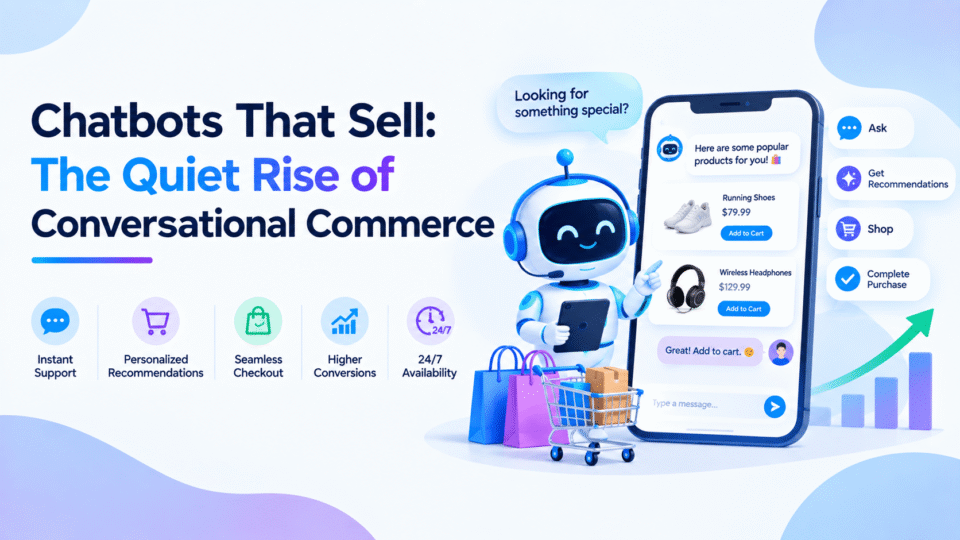
Conversational commerce is transforming the process of finding, researching, and buying products online. Customers can now ask a question, make comparisons, receive recommendations, and make purchases without having to navigate through multiple pages, using an AI Chatbot.
This transformation is turning chatbots from mere customer-support tools into something more. They are slowly becoming digital sales assistants, able to take customers on a journey through their purchase and make the process quicker and more personalized.
What Is Conversational Commerce?
Conversational commerce is an AI-driven, message-centric, and online shopping experience. A business can be reached by customers via its website chatbot, messaging application, social platform, or mobile application.
Users don’t need to look for information themselves; they can simply tell the system what they are looking for. The chatbot can then answer with relevant products, explain features, answer questions, and lead them toward checkout.
For businesses, this is a new way to meet customers when they are in the mindset to buy.
The Rise of Chatbots as Digital Sales Assistants
Historically, chatbots were created to provide straightforward answers or route customers to a help page. Today, AI-supported chatbots can process a lot more context and engage in dialogues similar to those with a salesperson.
A shopping chatbot could inquire about the price range, tastes, purpose, or functions the client is looking for. It can then narrow down the products that will be appropriate based on the answers it has received.
For instance, if a user is looking for running shoes, they might instruct a chatbot to provide shoes suitable for long-distance running, with a particular budget in mind, and lightweight options. The chatbot can narrow down the options and guide the conversation toward relevant choices instead of showing a massive product list.
Why Shoppers Respond to Conversational Buying
A common reason for online shoppers to bail on a website is that they can’t locate the information they’re looking for quickly. Conversational interfaces can eliminate this friction by bringing assistance right into the shopping experience.
A customer can ask:
- Which product is suitable for me?
- What are the differences between these two models?
- Does this item support a particular feature?
- Are there alternative options that are less expensive?
- When will it be delivered?
Natural language queries can simplify product discovery for customers who don’t have a concrete product idea in mind before they come to you.
Personalization Can Affect Buying Choices
Personalized interaction is among the best benefits of conversational commerce. Chatbots can adapt the recommendations for each visitor based on the information they receive during their chat.
Product preferences, price range, past interactions, and specific requirements are examples of personalization. If integrated with relevant business systems, a chatbot can also share information regarding inventory, promotions, orders, and customer accounts.
It is not just about displaying more products. It’s designed to make it easier for customers to locate the best product they need.
From Product Questions to Checkout
Of course, a conversational shopping journey is more valuable when it links different stages of the customer journey.
A chatbot can guide a customer through the discovery-to-purchase process by:
- Knowing the customer’s needs.
- Recommending relevant products.
- Explaining product differences.
- Dealing with objections or concerns.
- Displaying price and stock availability.
- Accompanying the customer to the checkout.
This decreases the number of different interactions that are needed for a purchase to be made. It can also help streamline the flow of information from marketing to sales to customer support for businesses.
Businesses looking to build and connect these capabilities may use AI chatbot development services as part of their conversational commerce initiatives.
Conversational Commerce Can Have the Most Impact in the Areas Where It Fits Best
Chatbots can serve to aid in sales in numerous sectors, especially when it comes to customer guidance before a purchase.
They can be used for product suggestions by ecommerce retailers, style advice for fashion companies, and tech specs for electronics retailers. Conversational interfaces can be utilized by travel companies to guide customers in their exploration of packages, locations, and booking alternatives.
The technology is also applicable to the after-sales stage. Users may request information on their delivery, returns, exchanges, or product usage without having to create an entirely new support process.
Businesses can also use artificial intelligence development solutions when conversational experiences need to work across different customer touchpoints.
The Challenges Businesses Have to Consider
Just placing a chatbot on a website doesn’t mean the transactional experience will be a success. Bad advice, incorrect information, repetitive answers, or challenging handovers can quickly irritate customers.
To make this a priority for businesses:
- Product and inventory information is correct.
- Clear escalation to human representatives.
- Good data-handling and privacy policies.
- Consistent conversational experiences.
- Ongoing monitoring and continuous improvement.
Where a request is complicated, of a sensitive nature, or beyond the scope of the chatbot’s functionality, human support will be necessary.
For businesses extending conversational experiences into mobile applications, AI development can support the implementation while keeping the original customer journey intact.
The Future of Chatbots That Sell
Conversational commerce is part of a larger shift in the way people are shopping online. Today’s customers are looking for companies that know what they want instead of just offering an online catalog and search feature.
With AI’s increasing ability to grasp context, chatbots can transform from mere assistants to proactive shopping companions. They can engage customers in finding products, comparing options, making personalized recommendations, and handling after-sales interactions in a single conversation.
So the slow ascent of chatbots that sell is not so much about taking the place of traditional e-commerce as it is about making digital buying more conversational, accessible, and responsive.
