
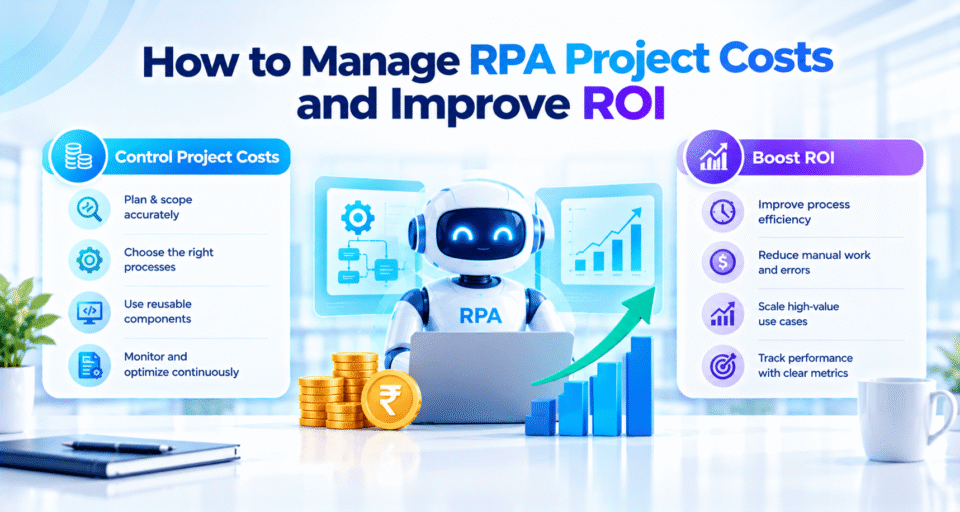
How to Control the Costs of RPA Projects and Maximize ROI
Robotic Process Automation (RPA) can be used to automate repetitive processes, save manual work, and boost operational efficiency. But there is no cost-saving guarantee for an RPA initiative. Uncontrolled project requirements, integration needs, maintenance costs, and lack of visibility into processes can cause additional project expenses and lower the anticipated return on investment (ROI) expected.
When it comes to sustainable ROI, businesses need to know how to calculate the overall cost of RPA deployment and have a solid plan in place for measuring RPA performance. By adopting the right strategy, organizations can manage costs, optimize automation results, and get the most out of their RPA initiatives.
1. Recognize the Various Costs Involved in Implementing RPA
The first stage of cost control in any RPA project is to list all costs involved in automation. Having a single-minded budget for software licenses can make for an unattainable budget and end up in unforeseen costs down the road.
Typical implementation costs of RPA involve development, deployment, infrastructure, integration, employee training, and maintenance. Leveraging professional Robotic Process Automation development services from the outset helps organizations map these costs accurately and avoid costly surprises during later stages. There may be more of an investment required to deal with exceptions in complex workflows, or to integrate the automation bots with existing business applications.
Before beginning a project, create a detailed cost estimate including:
- Requirements for software licenses and infrastructure
- Assessment of processes and development of automation processes
- The ability to integrate with the existing enterprise systems
- Testing, deployment, and employee training
- Monitoring, maintenance, and improvements for the future
Having insight into these costs can also help companies set realistic budgets and determine if the financial gain of automation will be enough.
2. Choose the Right Processes for Automation
RPA can’t be applied to all business processes. By automating a workflow that is inefficient or very volatile with little or no benefit, the development effort can be greater than the actual benefit.
Repetitive tasks that have established rules and require a lot of employee time should be the first choice for automation. There may be more opportunities for measurable savings for processes with high numbers of transactions.
Typical examples are invoice processing, data entry, report generation, payroll administration, and updating customer records.
Before choosing a process, assess: Frequency, Time to complete, Error rate, Business significance, Complexity of automation. Having a clear process in place helps organizations test their path and get a feel for what the implementation of greater automation will look like before committing to a larger project.
3. Start Small and Scale Gradually
Having several automation initiatives underway at once can cause financial and operational strain. A phased implementation approach allows organizations to handle costs and to learn from early implementation results.
Start with a pilot project to solve a specific business problem. Evaluate its impact before scaling up automation across other departments by comparing it with current manual processes.
A pilot can identify or highlight challenges for integration, requirements for exception handling, and training needs that could lead to higher implementation costs.
Once automation is demonstrated to generate measurable value, the same elements, development standards, and governance can be reused in future projects. Organizations that pair this phased approach with professional AI development services gain access to proven automation frameworks that minimize duplication and simplify future RPA deployment.
4. Decrease Maintenance and Operational Costs
After deploying an RPA solution, project costs are ongoing. Application interfaces may change, business rules may be updated, and source data may become inconsistent and cause bots to fail. A lot of failures may need more developer time and lead to delays in business operations.
These costs can be managed by setting up proactive monitoring and maintenance practices. Useful practices include:
- Tracking bot performance and failures in execution
- Writing workflows, dependency, and exception handling rules
- Conducting periodic automation effectiveness reviews
- Maintaining bots for updates whenever connected applications or business processes change
- Favoring standardization of reusable components for less development effort
Good automation means greater reliability, and it can help to avoid small technical problems from becoming costly operational issues.
5. When Considering ROI, Use Meaningful Metrics
By measuring ROI, businesses can assess if an RPA project is making the desired financial and operational impacts. But ROI isn’t just about the number of hours saved.
Organizations should monitor labour savings, processing time, error reduction, the number of transactions, maintenance costs, and the cost of continued automation.
The simple ROI formula is:
RPA ROI (%) = (Total Benefits – Total Costs) / Total Costs × 100
For instance, if an RPA project saves $100,000 in tangible benefits annually and costs $60,000 over the same period:
ROI = (($100,000 − $60,000) ÷ $60,000) × 100 = 66.7%
In this example, benefits and costs are measured over the same time period. Recurring costs should also be considered, and costs should not be double-counted. Teams building measurement dashboards alongside AI app development services can automate the tracking of these metrics, providing real-time visibility into RPA performance and ROI without manual reporting overhead.
6. Enhance Employee Adoption and Process Efficiency
Successful automation cannot be ensured by technology alone. It’s important that staff members grasp the implications of RPA on their roles and the management of automated workflows.
Train teams that need to work with bots, manage exceptions, or review automation outcomes. Engage employees in process assessment to determine inefficiencies and potential issues with implementation.
As routine tasks are automated, employees can concentrate on tasks that demand judgment, communication, and problem-solving. This can help to enhance productivity and make the most of the existing staff.
7. Set Up Long-Term Cost Governance
With increasing automation, a uniform approach to managing budgets, performance, and technical requirements is necessary. If not managed, departments can create duplicate bots, buy redundant licenses, or implement multiple solutions for the same purpose.
By implementing a centralized RPA governance framework, organizations can gain a better view of their RPA assets, control costs, define standards for development, and prioritize future automation initiatives. Organizations that also invest in AI software development services alongside RPA governance can extend these frameworks to include AI-driven monitoring and intelligent decision-making, further strengthening long-term operational control.
Routine performance reviews can also enable decision-makers to recognize underperforming bots and focus resources on more rewarding opportunities.
Conclusion
To ensure that an RPA project stays within budget, it is imperative to have proper planning, proper process selection, maintenance of processes, and continuous monitoring — this reduces financial risk and increases the effectiveness of processes, ensuring growth according to the efficiency achieved.
RPA projects can be made into sustainable business investments by measuring the overall implementation cost, calculating the ROI, ensuring employee adoption, and having governance. Organizations that approach automation with these principles in place consistently achieve stronger returns and more resilient operations over time.
